

Deep Sea Defenders is an all volunteer international organization started in September 2021 when the island nation of Nauru submitted a Plan of Work for deep sea mining to the International Seabed Authority(ISA) pursuant to Section 1, Paragraph 15(b) of the Annex to the 1994 Agreement relating to the Implementation of Part XI of the United Nations Convention on the Law of the Sea(UNCLOS) which requires the ISA Council to complete its work on the rules within two years of receiving such a request. It was because of this eminent threat from deep sea mining that we joined together in defense of the oceans. We are dedicated to protecting the integrity, stability and beauty of the deep sea environment, the organisms who live there, and the people who depend upon the health of the ocean for their traditional livelihoods. We oppose deep sea mining and support the call for a global ban.
Our vision is for a healthy ocean where natural communities thrive.
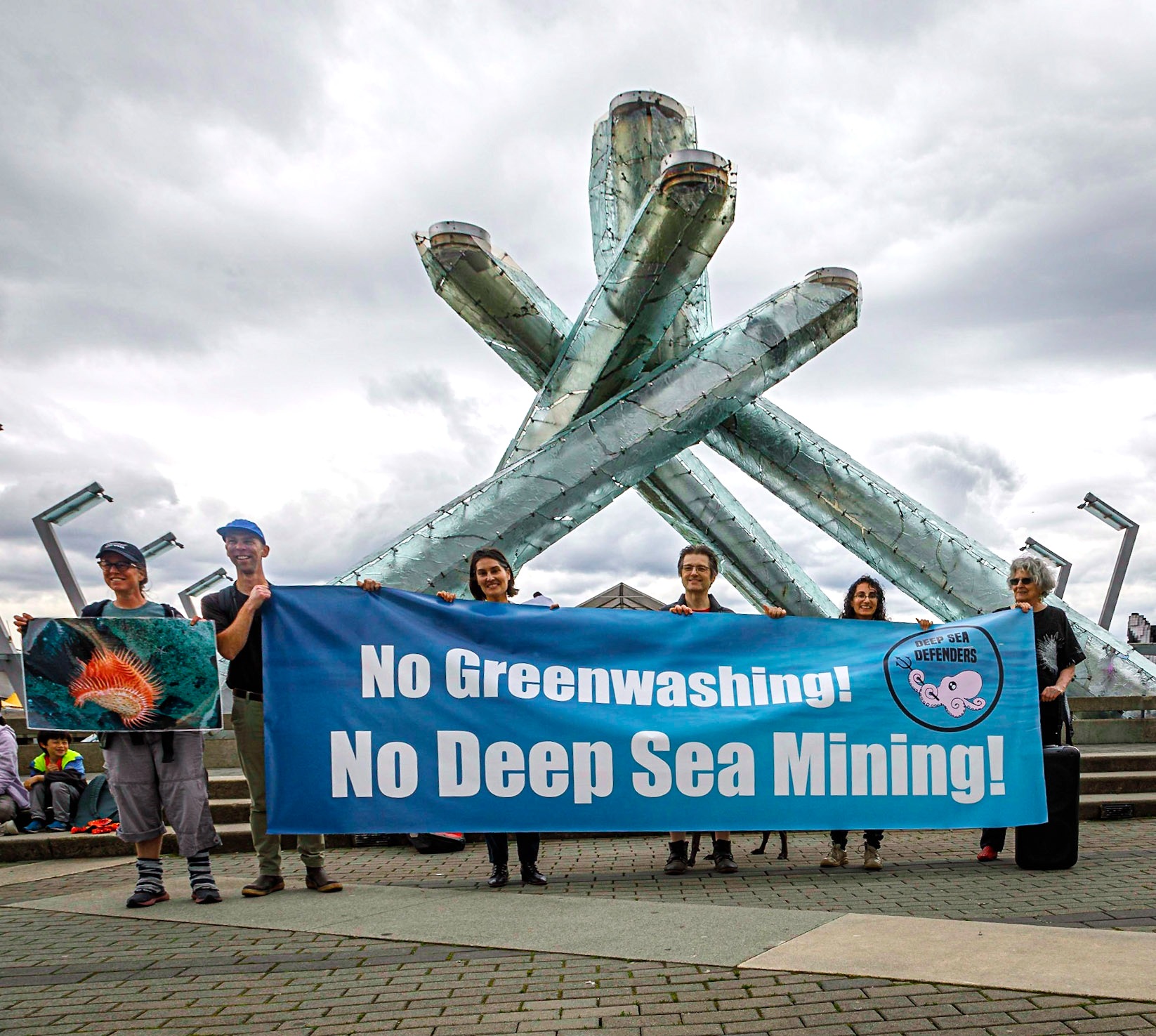
What is Deep Sea Mining?
Deep sea mining is a proposed expansion of the mining industry into the fragile deep ocean environment. Mining corporations want to extract metals found in areas of the sea below 200 meters.
They have focused on three types of mining.
1: The extraction of manganese nodules (also called polymetallic nodules) from abyssal plains
2: The extraction of cobalt-rich crusts from seamounts
3: The extraction of polymetallic sulphides from hydrothermal vents
All three varieties would be devastating to the organisms who inhabit those areas, and far beyond.
What are the risks of seabed mining?
- Habitat destruction
- Species extinction
- Noise and light pollution
- Sediment plumes that smother fish
There are currently no commercial mining operations in international waters, but there is growing pressure to begin exploitation, both in national and international waters.
The majority of the world’s oceans are located in areas beyond national jurisdiction. The seabed in these areas is under the jurisdiction of the International Seabed Authority (ISA).
The most imminent threat is to the Clarion Clipperton Zone, an area of the Pacific Ocean located between Mexico and Hawaii, targeted for manganese nodules containing small quantities of nickel, copper, and cobalt. The ISA has granted exploration leaseholds in this area to 16 deep-sea mining contractors, covering approximately 1 million square kilometers (400,000 square miles).
Among the silty substrate of the seabed in the Clarion Clipperton Zone, manganese nodules provide an essential hard surface for creatures like starfish, anemones, crustacean larvae, 4,000 year old corals, 11,000 year old sponges, and countless microbial species. As well as providing key habitat, they play a role in the carbon and nutrient cycles of the deep sea.
Seabed mining is incredibly risky and would cause irreversible damage to the oceans.
We have an opportunity to stop deep sea mining before it happens.
These countries/states have taken positions against deep-sea mining in international waters, national waters, or both:
Antigua and Barbuda, Austria, Brazil, Canada, Chile, Costa Rica, Croatia, Cyprus, Denmark, Dominican Republic, Ecuador, Federated States of Micronesia, Fiji, Finland, France, Germany, Greece, Guatemala, Honduras, Ireland, Latvia, Luxembourg, Malta, Marshall Islands, Mexico, Monaco, New Zealand, Norway, Palau, Panama, Peru, Portugal, Romania, Samoa, Switzerland, Sweden, Slovenia, Spain, The Assembly of French Polynesia, The United Kingdom, Tuvalu, Vanuatu.
What Can You Do Right Now To Help?
- Sign the Pacific Blue Line Statement
- Donate to our organization
- Follow our Facebook & Twitter pages
 Deep Sea Defenders